


The car battery is one of the key elements of the car’s power supply system. The stability of the engine start, the correct operation of electronic systems and the reliability of vehicle operation at any time of the year directly depend on its technical condition. At the same time, many car owners mistakenly believe that it is possible to assess the condition of the battery only with the help of professional diagnostic equipment. In practice, the primary diagnosis can be performed independently using simple methods for assessing the battery condition and measuring voltage.
It is important to understand that no test method without specialized devices allows you to 100% determine the remaining battery life or its actual capacity. However, a comprehensive assessment of the external condition of the battery, the behavior of the car when starting the engine and the voltage level allows timely detection of signs of decreased performance and measures to be taken before failure occurs.
External inspection of the battery. The first stage of diagnosis is a visual inspection of the battery case.
It is necessary to make sure that there are no mechanical damages, cracks, traces of deformation of the case and traces of electrolyte. Even a minor leakproofness can lead to accelerated destruction of the internal elements of the battery and loss of operational characteristics.

Special attention should be paid to the condition of the output terminals. The presence of oxides, white or greenish plaque increases the transient contact resistance, which leads to a voltage drop when starting the engine and a deterioration in the charging efficiency from the generator. If necessary, the terminals should be cleaned and a secure connection should be ensured.
It is also recommended to check the reliability of the battery mount. Vibration loads can accelerate the destruction of the active mass of the plates and shorten the battery life.
Indirect signs of decreased performance. Even without measuring instruments, the car often itself signals a decrease in the battery charge level.
The main features include:
- slow rotation of the starter;
- noticeable decrease in the brightness of the headlights when starting the engine;
- unstable operation of electronic systems before starting the engine;
- increased power unit start-up time;
- Frequent reports of low on-board mains voltage.
Such symptoms do not always indicate a malfunction of the battery — the cause may also be malfunctions of the generator, starter or increased energy consumption of the car. Nevertheless, they are grounds for additional verification.
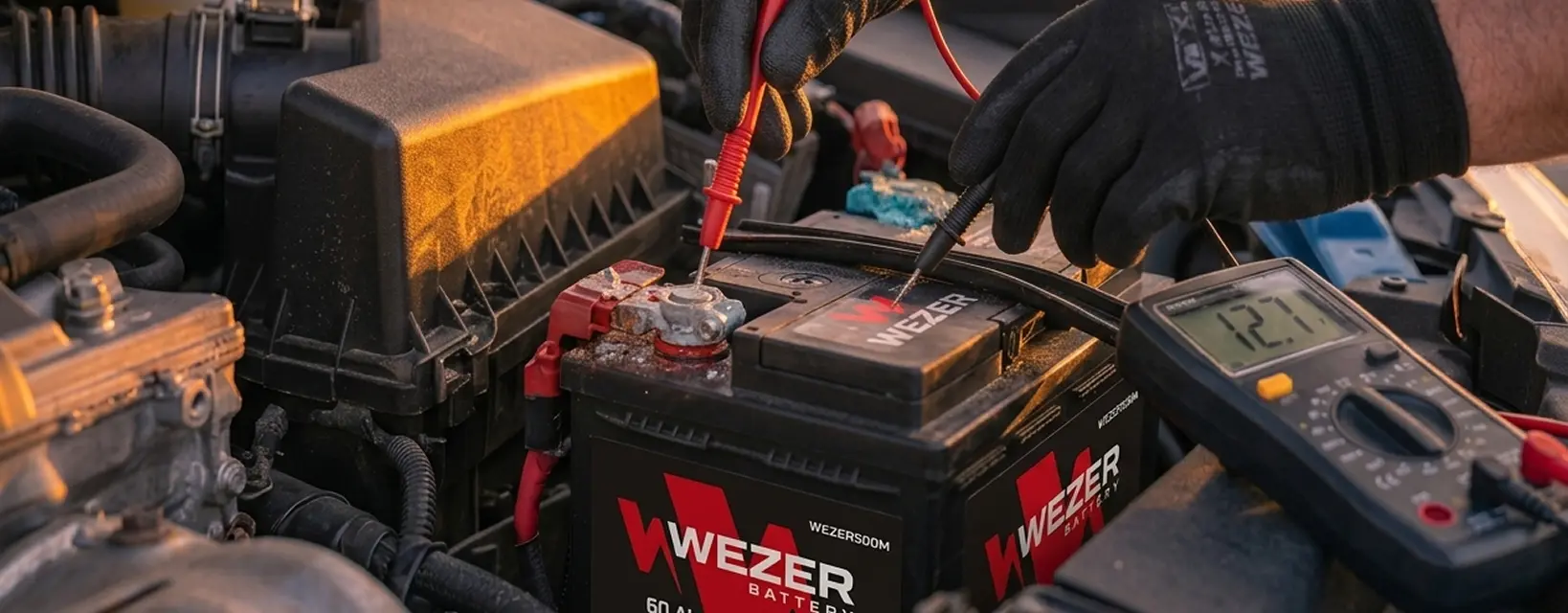
Voltage measurement is the most affordable diagnostic method. The most informative way to assess the condition of a battery in a household environment is to measure the voltage at the terminals.
An ordinary digital multimeter is enough for this, which today is the basic tool of most car enthusiasts. Despite the simplicity of the method, it is important to follow the correct measurement sequence!
It is recommended that the check be carried out after the vehicle has been without engine operation for at least 6-8 hours. During this time, the surface charge disappears, and the voltage most accurately reflects the state of charge of the battery.

What do the measurement results mean?
The voltage of a fully charged lead-acid battery at a temperature of about +20 °C is usually found in the range of 12.6–12.8 V.
If the device shows 12.5 V, the battery remains almost fully charged and ready for use.
A value of 12.4 V corresponds to approximately 75% charge. This level is not considered critical yet, however, when using the car regularly over short distances, it is recommended to perform preventive charging.
A voltage of 12.2–12.3 V indicates a decrease in the charge level to about 50%. Prolonged battery operation in this state accelerates the plate sulfation process and shortens battery life.
If the voltage drops to 12.0 V or lower, the battery is considered deeply discharged. In this case, it is recommended to charge as soon as possible using the appropriate charger. The operation of the battery in a state of deep discharge significantly increases the likelihood of irreversible loss of capacity.
At values of less than 11.8 V, either a critical battery discharge or the presence of internal defects requiring professional diagnosis can be assumed.
Please note that the ambient temperature affects the battery voltage. At negative temperatures, the voltage may be slightly lower, and the battery’s ability to produce high inrush current is noticeably reduced.
Check during engine start. Additional information allows you to monitor the behavior of the battery directly when starting the engine.
If the headlights dim abruptly when the starter is turned on, the dashboard turns off completely, or the characteristic clicks of the retractor relay are heard without turning the engine, this indicates a significant voltage drop under load.
A similar pattern may be caused by insufficient battery charge, high internal battery resistance, or deterioration of terminal contacts.
Monitoring the operation of the generator. Even a fully functional battery will not be able to start the engine for a long time with a faulty charging system. After starting the engine, it is recommended to re-measure the voltage at the battery terminals.
With a working generator, the voltage should be in the range of 13.8–14.5 V. It is these values that indicate the normal operation of the voltage regulator and the full charge of the battery.
If the voltage is significantly below the specified range, the car’s charging system should be checked. If the voltage exceeds 14.8 V, there is a risk of overcharging the battery, which also negatively affects its service life.
When is a professional diagnosis required?

It should be understood that voltage measurement allows you to evaluate only the current state of charge of the battery, but not its remaining life.
Even a fully charged battery may have significantly reduced capacity and may not provide the required starting current at low temperatures. Load testers, electronic conductivity analyzers, and specialized diagnostic equipment are used to determine the actual state of the battery.
Therefore, in case of recurring problems with starting the engine, rapid voltage drop after charging or battery operation for more than four to five years, it is recommended to carry out a professional diagnosis.
Regular monitoring of the battery status can significantly reduce the risk of unexpected vehicle failure and extend battery life. External inspection, monitoring the behavior of the car when starting the engine and periodic voltage measurement are simple but effective methods of primary diagnosis.
Wezer batteries are designed to meet the requirements of modern cars and are designed for stable operation in a wide range of climatic conditions. However, even a high-quality rechargeable battery needs periodic condition monitoring, compliance with operating rules and timely recharging. Simple prevention allows you to maintain reliable engine start, ensure stable on-board power supply and maximize the estimated battery life.